
Grahame Stuart* discusses how moving to all-electric conditioning could offer operating cost savings whilst reducing carbon emmissions.
All-electric forehearths are not a new concept. Electroglass has been designing and supplying them for many decades. Increases in gas prices, a focus on renewable energy sources and the growing requirement to reduce harmful emissions means that now more than ever this technology is being adopted by sectors of the glass industry that historically relied on gas heated systems. Perhaps the most important of these is the container glass industry.
With this increased interest comes a need to understand the various concepts being offered. Not all designs are equal in terms of ease of operation, ease of maintenance, consistent glass quality and the thermal efficiency to greatly reduce both energy consumption and operating cost.
The first of the factors to consider is the overall design concept offered. These fall into two broad categories. 1. Designs specifically developed for all-electric operation and 2. Gas heated designs heavily modified to run with heating elements, immersed electrodes or a mixture of both.
There are certain all-electric forehearth concepts that retain features traditionally associated with gas heated designs such as a few large damper openings, superstructure refractory design and insulation packages better suited to evacuating waste gases than they are to promoting efficient all-electric operation, forced air cooling systems and in some cases retained burner systems and chimneys for use during power failures.
Some of these designs employ immersed, dry type electrodes throughout the length of the forehearth, either as the primary means of heat application or supplementing radiant superstructure heating . When combined with the large damper openings and inefficient superstructure design localised cooling and reheating of the glass can lead to reboil and the glass defects related to it.
A further factor to consider with this type of all-electric forehearth is the design of the dry electrode. These can further compound glass quality issues in addition to those associated with reboil. In its simplest form a dry electrode can be made of two pieces of dissimilar metals, typically a piece of molybdenum connected via a thread to a piece of Inconel. This electrode is then sealed in the glass relying on the junction between the two dissimilar metals being positioned so that the molybdenum is not exposed to air in order to prevent oxidisation and the Inconel is not exposed to soft/molten glass.
The problems begin when the junction between the dissimilar metals is in contact with softened glass that is electrically conductive. Where this occurs a galvanic cell can be created leading to the generation of DC voltage and the creation of bubbles of pure oxygen. These bubbles not only impact on production yield, but also cause the molybdenum to oxidise creating molybdenum streaks in the glass and eventually, if left unchecked lead to the failure of the electrode and damage to surrounding refractory.
In terms of controlled cooling of the glass, Electroglass’ installations have long shown that a well-designed all-electric forehearth requires nothing more than passive radiation cooling through a series of relatively small, strategically placed damper openings along the centreline in the rear zones. Where forced air cooling is retained the passive nature of the cooling is lost, there is an increased risk of thermal shock failure to the heating elements and the accurate temperature control needed to operate the forehearth efficiently is negatively affected.
To fully benefit from the simple operation, minimal maintenance, high glass quality and low energy consumption potentially offered by all-electric forehearths it is essential to select a design that has been developed for this specific purpose, not one with compromises carried over from gas heated systems. It should be remembered that the purpose of the forehearth is to cool and condition the glass in a controlled manner so that when it arrives at the conditioning/equalising section it is thermally homogenous and at the required temperature for forming. Achieving this with minimal energy input and with only passive cooling is the goal in every Electroglass all-electric forehearth system and many factors within the design make this achievable.

The first consideration is the substructure and superstructure design. Unlike gas heated systems where there is a need to evacuate waste gases from the process, the all-electric forehearth should be designed to prevent excessive or unnecessary heat loss.
When designing any electric forehearth Electroglass uses the required maximum and minimum pull rates, entry temperature range and conditioning/gob temperature range to calculate the heat loss range required from the forehearth. From this the ‘R’ value of the substructure and superstructure materials and the required number of damper openings can be determined to ensure heat loss is not excessive and to ensure the forehearth remains as energy efficient as possible.
The next area to consider is the application of heat to allow heat loss to be controlled while optimising glass quality and thermal homogeneity. How this is achieved depends on the forehearth width, glass type and the glass colour(s). As mentioned already, the application of electrode heating throughout the forehearth will often create glass quality issues due to reboil. A more reliable solution is to apply heat within the superstructure using some form of radiant heating element.
Heating element selection and power system design are critical for low maintenance operation and a long operating life, and a number of factors should be considered.
First is the type of heating element. Is there a need for independent side to side control? Are certain areas of the glass surface across the channel width to be heated whilst other areas are cooled? Does the presence of bends or corners in the glass flow path require that the heat input needs to target a certain side of the channel? Electroglass considers each of these factors in every system.
Secondly, there is a tendency for the heating elements to increase in resistance as they age and this must be considered. The elements must be designed to allow for this aging to ensure they do not fail prematurely and the power system, particularly the transformers used, must be designed to have a sufficient current and voltage range to deal with this increase in resistance over the operating campaign while maintaining full power input capability.
The element supports and guarding arrangements must be designed so that the elements can expand and contract freely during operation, to ensure they are protected from mechanical impact and that the operators are protected from the risk of electric shock.
For most non-volatile glass types the use of heating elements within the superstructure is sufficient to ensure high glass quality and good thermal homogeneity. But, in some cases, particularly where low transmission or dark glasses are to be conditioned, the application of some electrode heating using our Temptrim electrode heating system may also be advisable. This electrode heating should be low power, have the ability to operate in various firing patterns with some level of independent control and be limited to the conditioning zone only.
For many in the glass industry the use of electrodes within the conditioning zone would cause concern and for some dry electrode designs these concerns are valid. This is particularly the case for the type of dry electrode already described above, where dissimilar metals can lead to quality issues and premature electrode failures.
Dry electrode design is therefore very important and a design where there is no dissimilar metal contact, without the increased risk of oxidisation is something that we have achieved with our Sheathed Dry Electrode. This design gives the glassmaker the confidence to install dry electrodes close to production knowing that the risks to glass quality can be avoided. Electroglass manufactures a large number of dry electrodes each year. Many are replacements for other dry electrode types in customers’ existing systems designed and supplied by others and where issues have been experienced with glass quality and electrode failures.
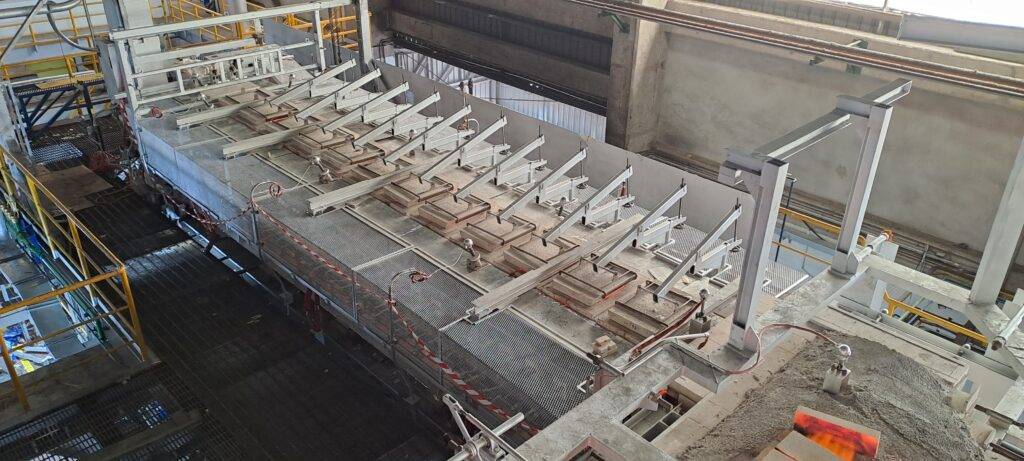
Considering the above points when selecting an all-electric forehearth design will help to ensure high glass quality, energy efficiency and simple operation are achieved. The majority of the all-electric forehearth projects Electroglass undertakes are for customers looking to convert existing gas designs to all-electric in order to help reduce their carbon footprint and to also reduce their operating energy costs. With such projects it is important that the conversion can be completed quickly, with minimal disruption to production and with minimal modifications to the existing forehearth layout, gob drop points, support steelwork and casing arrangements. In our initial assessment of any project we will identify the forehearths that will be most beneficial to the customer meaning those that will save the most operating energy cost to help free up funds for other carbon reduction and energy saving projects.
With this in mind we have developed a system that allows us to evaluate the operating cost savings and capital investment costs quickly and easily. This system requires minimal information from the glassmaker on their existing forehearths such as dimensions, pulls, operating temperatures, energy consumptions and energy prices. In most cases this is done by completing a very simple questionnaire. For larger systems, or where the distributor is also being considered for conversion to electric then additional information may be needed.
It is not unusual for us to receive information for multiple forehearths from several furnaces. With the energy consumption and operating cost calculation system we have in place we can usually give initial capital cost and energy saving estimates in just a few days.
Forehearth operating energy cost savings of between 60% and 80% are typical and it is not unusual for customers to see energy cost savings of up to 90%. This can mean that carrying out conversion will be beneficial long before a scheduled furnace shutdown or repair is planned. Where this is the case it is possible to install our design of Electroflex forehearth during a short shutdown of individual forehearths, without waiting for the next major repair. Such an operation typically requires a forehearth stoppage of as little as 14 days.
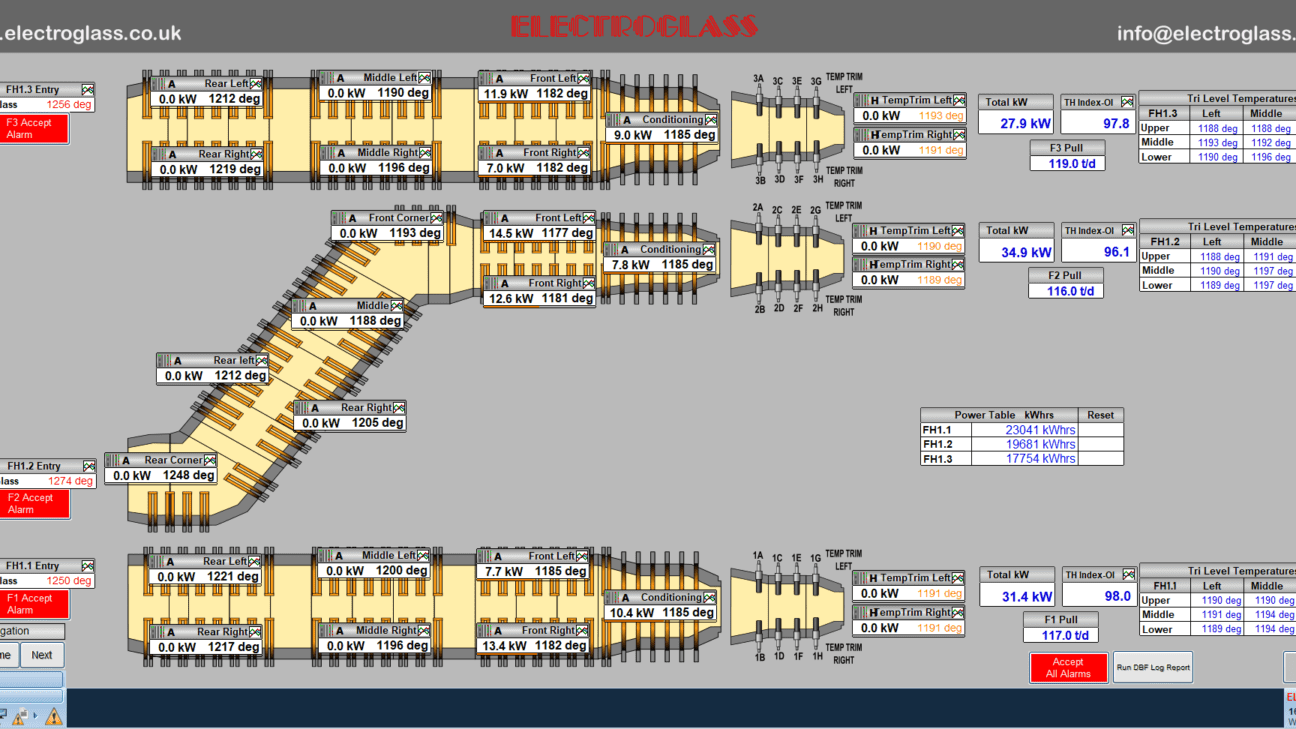
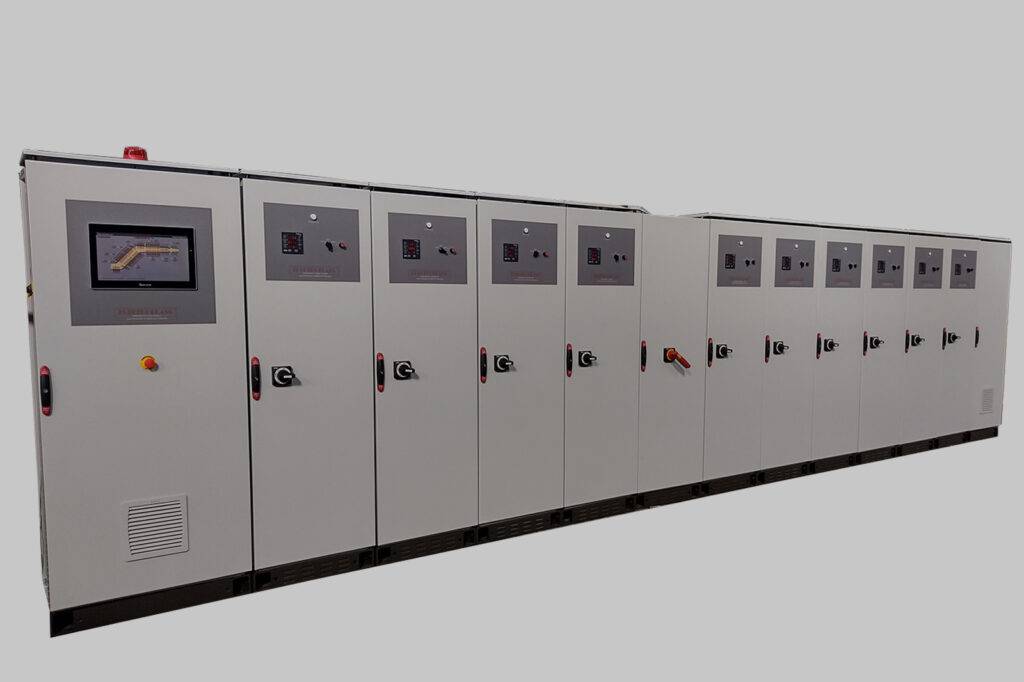
In the week or so leading up to the stoppage, new power and control equipment will have been installed and the required thermocouple and power cables run. The Electroglass power and control system is a modular design whereby all control and communications are run via network cables from the power racks to the control panel. An internal main isolator and busbar systems mean only a single set of incoming power cables will be required. For single forehearths a blind interface allows the system to be viewed, monitored, and controlled over the factory network via a web browser. Where multiple forehearths are involved, or will be in the future, a new SCADA control system can be included. There is also the option of monitoring and controlling the forehearths on the customers’ existing factory computer system.
Once the Electroglass power and control equipment has been successfully installed and tested the existing gas forehearth can then be stopped. The existing superstructure, insulation, glass contact and substructure material are then removed. The steel casings and spout remain in place and our new design will maintain the existing gob drop point. In some cases, it may not be essential to replace the glass contact and substructure refractories. This can be discussed when planning the forehearth replacement.
Certain modifications are then made to the casings to accept any superstructure steel, damper mechanisms and Temptrim electrodes required for the new build.
New substructure (where applicable) and superstructure materials of Electroglass design are then installed. Superstructure bracings, damper assemblies, and busbars are added.
Lastly, heating elements, thermocouples and safety guarding is installed making the forehearth ready for heat-up.
Heat-up times vary depending on glass contact material, but typically range from between 4 and 7 days.
Once back in operation, Electroglass engineers will carry out final commissioning, customer training and remain present for several days whilst the forehearth is brought into full, normal operation and the customer can begin benefiting from the significant energy cost savings, improved thermal homogeneity, simplified operation, and minimal maintenance requirements of our Electroflex design as well as removing reliance on fossil fuels in this important area of their operation.
As demonstrated, there are significant and important differences in the concepts that various designers have used in their all-electric forehearths which can significantly affect operating cost, energy consumption, thermal homogeneity, and operating stability.
As an example, a recent comparison between an Electroglass Electroflex All-Electric Forehearth and an alternative all-electric design showed the energy required for the alternative could be more than 5 times higher!
ABOUT THE AUTHOR:
Grahame Stuart is Technical Sales Manager at Electroglass Ltd